I figured I'd dust off the old (very old, very dusty) blog to document my journey in training for my 300 mile Climate Ride in September (for those of you unaware here's my story! and you can donate here too!) I'm getting some fairly high mileage this week but it's only because I'm back in the gym.
Indoor training has definitely got its perks:
• I can only wear so much sunscreen—I'm turning darker than my old Finnish grandmother, I'm starting to loop around to purple.
• 2 1/2 hours on the bike is spent always in motion, as opposed to outside where you're stopping for traffic lights and fighting the wind and hills
• distraction... indoors, I can check emails, surf the web and I've also set a goal for myself to read 100 books while I'm training which makes the time go by that much faster. Today on the bike, I finished "The Cheapskate Next Door: The Surprising Secrets ofAmericans Living Happily Below Their Means" by Jeff Yeager—a fitting inspiration, because Yeager did his entire book tour by bike! This one's classified as "humor" but he really has truly practical advice for anyone who wants to easily save money. Gotta love a guy who tells everyone to go check his book out at the library.
Miles to go before I sleep, but check back for daily updates here!
T-Minus: 91 days
Fundraising to go: $1515
Total training miles ridden: 568.41
Total books read since started: 15
Showing posts with label Reading List. Show all posts
Showing posts with label Reading List. Show all posts
Friday, June 20, 2014

Saturday, September 29, 2012
Reading List: Oceana (2011)

Most people know Ted
Danson as the loveable Sam Malone from Cheers, but what isn’t as public is his
support for environmental conservancy, specifically the sea. This is hands down
one of the best environmental books of the last few years…not only is it
aesthetically beautiful, what’s written inside is both awesome and thoroughly
frightening. It was a shock to learn that probably because of their vast size,
oceans don’t have the same protections that other bodies of water do. Many
think that the oceans are the environmental equivalent of “too big to fail”,
when reality shows they are just as vulnerable as everything else. I’ll let the
quotes speak for themselves:
p. 69 “The current rate
of destruction and death among the world’s coral reefs due to a multitude of
threats including trawling and bleaching is—there’s no better word for
it—horrifying. Close to 30% of the world’s tropical reefs have vanished since
1980, including half of the reefs in the Caribbean.”
p. 89 “Experts say we’re
within a century—possibly even less—of inhabiting a world where the only viable
seafood left in the oceans will be jellyfish.”
p. 130 “Calculations
show that the total area of seabed trawled by the worlds fishing fleet each
year is 150 times the area of the forests cut.”
p. 182 “You show me a
polluter, and I’ll show you a subsidy.” Robert F. Kennedy Jr.
p. 186 “Factor in the
destruction caused by that deep-sea fishing and you’ve got a triple whammy: The
public is paying to help catch those fish, we’re paying to eat them, and we’re
paying to help destroy our oceans in the process. I don’t think many of us
would support fishing subsidies if we were fully aware of these facts.
Sunday, August 14, 2011
Reading List: In-N-Out Burger (A Behind-the-Counter Look at the Fast-Food Chain That Breaks All the Rules)

It’s no secret how much I love In-N-Out burgers… and after reading the In-N-Out Burger: (A Behind-the-Counter Look at the Fast-Food Chain That Breaks All the Rules
by Stacy Perman) I’m now head over heels. All super-fans have their quirks—I liked learning that like me, Julia Child used to keep a map of locations with her and that I’m not the only one who plans my travel according to how early I can get a Double Double (10:30A) and route myself around to hit up a location I haven’t been to yet.
The definition of corporate simplicity and amazing business model:
• “Do one thing and do it well”: A basic menu that includes no more than 10 choices (with a secret menu that makes variations limitless), choices that have changed minimally in their 60 years in business—a direct contrast to most fast food restaurants which trot out a new menu item several times a year (For a limited time only!) in hopes of bringing in more traffic.
• In-N-Out’s motto “Quality you can taste” should be followed with “Do what you love and have fun doing it”, as shown by the smiles and courteousness of their employees. Not once in 15 years have I noticed a bored or sullen employee.
• Their original expansions were done only when they had enough cash to buy new store locations. The In-N-Out dining experience remains special occasion because in 60 years, they’re only hitting 265 locations (in contrast, McDonalds now has over 32,000 locations.)
• Harry and Esther Snyder, the founders have always paid their employees a fair wage, often several dollars higher than the minimum wage.
• The company routinely makes the top of fast food customer satisfaction lists and was about the only chain that emerged from Eric Schlosser’s Fast Food Nation unscathed.
• Their online customer service is a dream…I sent a ‘hey thanks for all you do and could you open a new location’ email on a Sunday morning, I had a personalized response within 10 minutes.
Thursday, February 17, 2011
Reading List: More Good News (by David Suzuki & Holly Dressel)
I have to say, this book made me feel a little better about this world we live in... when I first began writing The Simplicity Connection 11 years ago, I was originally going to call it Who Gives a Damn because it was a period of time when it seemed no on cared about the environment or helping others. Now, a quick stroll through Twitter or popping the word “eco-conscious” into Google Search and you get a feeling that everyone and their brother has jumped on the eco-band wagon. Don’t get me wrong, there’s a very very long way to go, but I believe the country is poised to make so definitive changes to its environmental policy. Case in point, Suzuki’s book… (the revised and updated version his book Good News for a Change) they provide inspiring stories about how ordinary business people are changing the way they do business to become more sustainable and still be profitable. Amazing stories of a sustainable forestry company (Collins Pine), how micro-loans are changing entire economies of 3rd world countries $50 at a time (The Grameen Foundation) and an inner city food co-op that is not only keeping it’s constituents fed, but teaching them the benefits of organic farming and management of waste and energy usage (Growing Power). The future may be bleak if you only listen to the popular media outlets...instead when you learn to read deeper to find the hidden heroes, you find the hope.
Wednesday, February 17, 2010
Help get “The Simplicity Connection” into the Los Angeles Public Library!
Go to this link, http://www.lapl.org/forms/purchase.html and fill in the blanks (the answers are The Simplicity Connection, C.B. Davis, Trafford Publishing 2009, ISBN: 978-1-4251-4998-7) you don't even have to be a card holder to suggest a purchase. Thanks!
Tuesday, February 16, 2010
Reading List: Sleeping Naked Is Green: How an Eco-Cynic Unplugged Her Fridge, Sold Her Car, and Found Love in 366 Days (Vanessa Farquharson)

The highlight for me was when she got No Impact Man Colin Bevan to admit how exactly he and his family gave up using toilet paper for their own year-long challenge-information that was not included in Bevan's book or documentary and answers he would give to interviewers were always curt and left the question unanswered. She did write one of my favorite new quotes about: “the compost hitting the wind turbine”.
If you're looking for solutions, it is worth a scan only if you are new to the challenge of being more environmental but if you've been around the eco-block a time or two, the list will leave you thinking you've heard it all before. (or you can just head to her blog, which she's since stopped updating, the full list of 366 changes is: http://greenasathistle.com/green-listed/)
Friday, January 01, 2010
Resolving to Resolve
Wow, a whole new year, a whole new decade. Wonder where that came from? I’m not really big on making resolutions on January 1… probably because I’m so busy making them the rest of the year. I mean I have list after list of things I want to accomplish (I even spent yesterday’s flu-ish day on the couch reading a book about To-Do lists. And proud of it. Sasha Cagen’s To-Do List, good read so far.) I have weekly to do lists, I have monthly to do lists, I have daily to do lists. I have list after list of things that need to get done, things I keep putting off and things I put on there just so I’ll cross them off quickly and think that I’m accomplishing something. But if I were asked to make a resolution for this year, I’m going to go with a bad habit or two—stopping my disposable plastic habit. No more take away silverware, or throwaway cups. If I’m eating out, I’m eating in and asking for it unwrapped, and bringing my own cup. I’ve failed miserably at this attempt in the past, but I think with the right amount of preparation, I can get it ingrained enough to be like bringing my own reusable bags. It’s just a matter of having the right tools on hand when you need them. So happy first day of 20-10, y’all.
Thursday, November 05, 2009
Book Review: No Impact Man

I'm a sucker for any book that poses a year-long eco-challenge to itself (See my reviews for: Plenty, Animal, Vegetable, Miracle, Not Buying It (okay I meant to review this one, but it slipped through the cracks), A Year Without 'Made in China') but what makes Beavan's book unique, is that he combines all of the challenges posed by these other books and tries them all at once. While living in New York City. With a toddler. A grand undertaking indeed. Now I realize there are people out there thinking “what a presumptuous jerk! There are people who live like that every day, not because they want a challenge, but because they have to.” But the issue is that so many people do not want to consider live as he does—eating locally, not driving or taking mass transit, not using electricity (!!), (there was also some note about also not using toilet paper but it wasn't revealed how exactly they went about this). With the title of the book 'No Impact', it's pretty big boast, but on only page 22 he admits that having 'no impact' is actually impossible, but what you learn slowly is that he can lessen his impact so much that he can make up for what waste and destruction he does create with simple actions like picking up litter along the riverfront. He won me over by not only talking the talk but walking the walk. Shutting off the electricity? That's a pretty bold maneuver. Sure I've got the worm bin chewing up my scraps and I can make less than a plastic grocery bag full of trash a month, but this guy washed his own clothes in the bathtub and read by candlelight for months. And that's pretty cool. He's a minor celebrity now, with his blog and his documentary but I'm happy to support anyone who preaches the gospel of needing to simplify your life no matter where you live and finding creative solutions to do so.
Look, I like to consider myself a fairly environmentally sound person (in the grand scheme of things) but I also don't pretend that I'm something I'm not: we all have our vices and that's a great thing about simplicity-it's not about deprivation. It's about being conscious of your actions and not allowing those vices to get out of hand. I love In-n-Out Burger, and I don't want to imagine giving it up, so instead, I use it as a treat, a reward. I also try to keep learning about creating less waste and lowering consumption and staying mindful about my actions. I also am working on my strength as an activist, so that someday I'll convince those In-n-Out folks organic meat and vegetables are the way to go, or to recycle their paper waste, or to have non-plastic options for eat in service.
Monday, November 02, 2009
Book Review: Wake Up and Smell the Planet

Finally was able to track down this little book from the editors of grist.org (“Gloom and Doom with a Sense of Humor” or “A Beacon in the Smog” I can't figure out which tag line of theirs I like better…and no I'm not reviewing just because it'd be nice for them to return the favor, it's all altruism right now, baby.) Originally published in 2007, it's packed with no-nonsense tips on how to start and get through your day a little greener. Even a crusty old broad like me who has “picked all the low hanging fruit” of environmental tips out there was able to find some peaches in this quick (and very funny!) read. Even came across a few “oopsies” that I'll be getting into in later posts once I get my eco-wagon back on the tracks. And even if you don't have time for another book on your nightstand, check out their daily dispatches at grist.org.
Thursday, April 16, 2009
Kindred Spirit Series
 Thought I would start a new blog series here about people I come across out there in the that I can totally relate to. So without further ado, please welcome the KINDRED SPIRIT SERIES. Our inaugural spirit is Jenna Woginrich, author of Made from Scratch: Discovering the Pleasures of a Handmade Life, a great little book about how anyone can homestead, regardless of where you live. Jenna wrote the book while living in apartment in Idaho and beginning her journey into homesteading by accumulating chickens, sled dogs, honey bees and a love for heritage music and instruments. She now apparently lives in Vermont and blogs from her new home The Cold Antler Farm. As someone who always wanted their own sheep and bees, Jenna’s story makes me realize that a connection to traditional ways is not impossible, no matter what your ZIP code is, what your job is, and no matter how much technological and sensory overload invades our lives.
Saturday, March 07, 2009
Reading List: "Greasy Rider: Two dudes, one fry-oil-powered car, and a cross country search for a greener future." (Greg Melville, 2008)
 When Greg Melville needed a new car, he and his wife decided to try a greener route: why not buy an old diesel powered automobile and convert it to use 100% vegetable oil as fuel. Once they secured a 1985 Mercedes wagon and retrofitted it with a Grease Car system, Greg grabbed a friend (Iggy) and set out on a cross country road trip (Vermont to California with a few detours) to be (what he thinks) the first person ever to cross the nation in a vehicle solely powered by used vegetable oil. (Seems weird that it’s taken someone this long to come up with this challenge, and even the author prefaces every mention of it with “we think”). Converted Grease Cars are an intriguing idea, as they do keep (usually) older vehicles out of the waste stream and prevent a least one new car from being purchased. But more important is to realize is that they use 100% used cooking oil, (a waste product that most fast food restaurants actually pay to have taken away) to power a car and that is pretty darn cool.
The whole book feels a little thin—it feels that he had to fill it up with a lot of side trips that had nothing to do with the challenge (who cares if a college friend they visit turns out to be gay?) The “errands” that Iggy challenges Greg with are interesting enough (a trip to Google headquarters would make any eco-nerd salivate) but we’re still left wondering what happened to the bio-wagon after the cross country trip. It’s a nice story that does prove it can be done, you just have to WANT to do it; to quote Iggy “…if two goobers like us can actually get in a car and drive across the country without fossil fuels or putting a lot of carbon into the air, the answers for sustainability are easier than people think.”
Saturday, February 28, 2009
Reading List: "Animal, Vegetable, Miracle: A Year of Food Life (Barbara Kingsolver, 2007)
 Continuing with my habit of reading any book that consists of an environmentally-themed personal challenge, Animal, Vegetable, Miracle, fell right into that category. Kingsolver (most notably the author of The Poisonwood Bible) sets out with her family to eat only either what they can grow themselves or what was created locally (150 miles seems to be their “local radius”) for one year. Unlike the couple in Plenty (known as the “100-mile dieters”) Kingsolver and clan have a Kentucky farmhouse and enough knowledge of animal husbandry and agriculture to support it. (They also seem to handle issues with each other much better than the Plenty couple did.) Their admirable quest is made even more interesting by their commitment to heirloom varieties. Anyone can throw a handful of agro-conglomerate seeds in the ground and tend what grows, but it takes real patience to hunt down and nurture varieties that are all but extinct and unknown to the average American. (Most notably, instead of raising Broad-Breasted White Turkeys [which is what over 99% of all American turkey meat is] and instead raise Bourbon Reds, an heirloom variety. They must try to re-awaken the mating instinct that has essentially been bred out of the bird due to artificial insemination.)
While she insists that their lives were more than planting, hoeing, weeding, watering, picking and canning, the reader is left somewhat in doubt. (There are just not enough hours in the day to hold down a full time job and support a farm this size.) But for the average American with a small corner of land or room for a few containers for gardening, it is an otherwise inspiring tale of truly creating your own food supply.
Saturday, February 21, 2009
Reading List: "Confessions of An Eco-Sinner" & "Where Am I Wearing"

While being waylaid with a chest infection, I’ve had plenty of time to sack out on the couch and catch up on some light reading. Well, and with the absence of any fluffy tomes on my reading list, instead I picked a couple of “where my stuff is from” books. Both “Where Am I Wearing: A Global Tour to the Countries, Factories and People That Make Our Clothes” (Kelsey Timmerman, 2008) and “Confessions of an Eco-Sinner: Tracking Down the Sources of My Stuff” (Fred Pearce, 2008) give the reader an insight into where and how everyday items are created. Both books covered “sweatshop” conditions but both challenged the notion that “sweatshop” is always a bad concept. Timmerman traveled to China, Bangladesh, and Honduras to uncover how his favorite items of clothing were made. What I liked most about his book was the photographs and stories he included about the real workers. And while the conditions that these workers are exposed to are what we consider low pay, long hours and toxic working conditions, he debates that if there was a boycott on the items that they make, these people would have even less than they have now.
 Pearce’s book expands the search from clothes to other consumer goods such as coffee, computers, where his trash goes and even where his wedding ring came from. His book also opened my eyes to things I never knew existed (did you know there is a gold mine in South Africa that has supplied more gold to the planet than anywhere else on earth and that at any time there are 60,000 men working underground?) but also changed my mind on conventional thinking: (they have noted that it takes less energy to make virgin paper from trees than it takes to recycle old paper into new, that if everyone on the planet emitted as much carbon as the average Chinese person, there would be no climate crisis, that around polluted sewage drains there seem to be a higher abundance of thriving wildlife as compared to clean areas, and that if current population rates continue, the only population crisis will be that there are not ENOUGH people to support the human race.)
Both books are good examples on why we should never stop learning about where our “stuff” comes from and where it goes to once we’re done with it.
Thursday, March 20, 2008
Reading List: "Stirring It Up"

Just finished reading Gary Hirshberg’s new book “Stirring It Up: How to Make Money and Save the World”… Hirshberg is the founder and CE-Yo of the Stonyfield Farms Yogurt empire and long time fighter of the good fight in terms of organic farming, recycling and all-around ecological goodness.
Hirshberg is positive about our ability as a society (and specifically business owners) to turn things around and I think that’s an important trait for this type of book. Too much of the ecological reading of late is all doom and gloom without positive solutions to back it up. He presents other companies that are also making headway into making a difference (many of the usual suspects are recapped here) Clif Bars, Patagonia, Newman’s Own, and Timberland but a few others that one might not expect like WalMart, who have come a long way in their struggle to no longer be deemed the root of all evil. Overall, a pretty good quick read with positive themes and important details on why we should all take a little more interest in how companies do business in the age of climate change.
Saturday, March 08, 2008
12 Resolutions February Wrap/ March intro
February wrap up:
Well it’s very evident that I am a horrible vegetarian. I started the month off and only 2 days later, a slip. I probably slipped about 4 times before I got to the final week of the month, and there is where it all went off the rails as they say…it was just too easy not to think about what I was eating. (I think I finished the last day with a big bowl of Texas chili, but hey, when in Dallas. I'll have it known, I had the tuna when we ate at Morton's.) So I might revisit this goal later in the year to see if I can try to be better at it, but for now, a definite failure. But March is another day, isn’t it Scarlett?
So March’s goal is roughly based on Sara Bongiorni’s book “A Year Without ‘Made in China’.” It was her decision to try to survive a full year without any product purchased for her family bearing that ubiquitous ‘Made in China’ label—a fairly easy undertaking for me who doesn’t shop often and lives alone, but she felt overwhelmed by having to feel like she wasn’t depriving her two children (both under the age of 5). In fact, I disagree a bit with her methods: It is slightly cruel to spend a child’s life telling them that toys are great and wonderful and then all of a sudden change your mind and say “Nope, no more China toys,” cutting them off cold turkey. And then parade them up and down a toy store aisle showing them all the things they can no longer have. When her kid cries to her and asks her to have 2 more children and tell them when they’re born and not when older that China things are bad, even a four-year old gets it. Because nearly every toy sold in America is manufactured in China. Last year’s lead paint scare has probably done little to change the fact that toys are Chinese.
The other issue I have with her boycott is that she is boycotting products that are indigenously Chinese: she feels guilty that she overlooked that Mandarin oranges are Chinese, which seems silly to me—the point of the boycott was to show how China has taken over production of so many products that were originally produced in other places, as far as I can tell, Mandarin oranges are exclusively Chinese.
The Bongiorno’s boycott has made them more thoughtful, more conscious of their shopping habits and that is exactly what I am going to do with my own attempt at a Chinese boycott this year. I’m going with a cold turkey boycott for the month of March, and hopefully continue with a “buy China when it is the only practical option” in the future. But I plan to keep my purchasing traits unaffected: the best way to stay free from China products or (other sweatshop goods) is to stay a conscious consumer: buy only what you need, buy from reputable companies, buy for durability, dual function and take care of it once you get it home!
Well it’s very evident that I am a horrible vegetarian. I started the month off and only 2 days later, a slip. I probably slipped about 4 times before I got to the final week of the month, and there is where it all went off the rails as they say…it was just too easy not to think about what I was eating. (I think I finished the last day with a big bowl of Texas chili, but hey, when in Dallas. I'll have it known, I had the tuna when we ate at Morton's.) So I might revisit this goal later in the year to see if I can try to be better at it, but for now, a definite failure. But March is another day, isn’t it Scarlett?
So March’s goal is roughly based on Sara Bongiorni’s book “A Year Without ‘Made in China’.” It was her decision to try to survive a full year without any product purchased for her family
 bearing that ubiquitous ‘Made in China’ label—a fairly easy undertaking for me who doesn’t shop often and lives alone, but she felt overwhelmed by having to feel like she wasn’t depriving her two children (both under the age of 5). In fact, I disagree a bit with her methods: It is slightly cruel to spend a child’s life telling them that toys are great and wonderful and then all of a sudden change your mind and say “Nope, no more China toys,” cutting them off cold turkey. And then parade them up and down a toy store aisle showing them all the things they can no longer have. When her kid cries to her and asks her to have 2 more children and tell them when they’re born and not when older that China things are bad, even a four-year old gets it. Because nearly every toy sold in America is manufactured in China. Last year’s lead paint scare has probably done little to change the fact that toys are Chinese.
The other issue I have with her boycott is that she is boycotting products that are indigenously Chinese: she feels guilty that she overlooked that Mandarin oranges are Chinese, which seems silly to me—the point of the boycott was to show how China has taken over production of so many products that were originally produced in other places, as far as I can tell, Mandarin oranges are exclusively Chinese.
The Bongiorno’s boycott has made them more thoughtful, more conscious of their shopping habits and that is exactly what I am going to do with my own attempt at a Chinese boycott this year. I’m going with a cold turkey boycott for the month of March, and hopefully continue with a “buy China when it is the only practical option” in the future. But I plan to keep my purchasing traits unaffected: the best way to stay free from China products or (other sweatshop goods) is to stay a conscious consumer: buy only what you need, buy from reputable companies, buy for durability, dual function and take care of it once you get it home!
Monday, December 31, 2007
'Tis the season...For a good book.
Holy mackerel, it’s the end of the year again… and what better way to celebrate for a big old dork like me, than to countdown the top 5 eco books (in my humble opinion) of the year.
 #5: The Green Book: The Everyday Guide to Saving the Planet One Simple Step at a Time, Elizabeth Rogers and Thomas M. Kostigen. Lots of celebrity testimonials such as Will Ferrell and Cameron Diaz. A quick read with lots of simple “going green” tips for everyone.
 #4: Get Satisfied! How 20 People Just Like You Found the Satisfaction of Enough, ed. Carol Holst. Okay, of course my pals at Simple Living America are getting a shout out, but the book is truly a great example of how simplifying your life can lead to happiness. I’m so proud of SLA for taking the book from concept to reality, in just a year! Yay team!
 #3:
#3:
Plenty: Eating Locally on the 100-Mile Diet by Alisa Smith, J.B. Mackinnon. Couple Smith and Mackinnon decided to try eating only ingredients that were produced within a 100 mile radius of wherever they were for an entire year. While it was never an easy task for them, their journey was very intriguing to follow.
 #2: This Moment on Earth: Today's New Environmentalists and Their Vision for the Future, John and Teresa Heinz Kerry. My favorite political ecology book of the year (Sorry Al…) The Kerry’s style was very accessible and gives more productive examples of ordinary citizens doing good in the face of climate catastrophes.
 #1:
#1:
Deep Economy: The Wealth of Communities and the Durable Future, Bill McKibben. I’m not shy to admit that McKibben is one of my all time favorite authors and heroes, so when he releases a new book, I’m a little biased. But bias notwithstanding, he gave us all something to think about this year with his thoughts on how to reevaluate how we spend money as a society and return to localized economies.
 #5: The Green Book: The Everyday Guide to Saving the Planet One Simple Step at a Time, Elizabeth Rogers and Thomas M. Kostigen. Lots of celebrity testimonials such as Will Ferrell and Cameron Diaz. A quick read with lots of simple “going green” tips for everyone.
 #4: Get Satisfied! How 20 People Just Like You Found the Satisfaction of Enough, ed. Carol Holst. Okay, of course my pals at Simple Living America are getting a shout out, but the book is truly a great example of how simplifying your life can lead to happiness. I’m so proud of SLA for taking the book from concept to reality, in just a year! Yay team!
 #3:
#3: Plenty: Eating Locally on the 100-Mile Diet by Alisa Smith, J.B. Mackinnon. Couple Smith and Mackinnon decided to try eating only ingredients that were produced within a 100 mile radius of wherever they were for an entire year. While it was never an easy task for them, their journey was very intriguing to follow.
 #2: This Moment on Earth: Today's New Environmentalists and Their Vision for the Future, John and Teresa Heinz Kerry. My favorite political ecology book of the year (Sorry Al…) The Kerry’s style was very accessible and gives more productive examples of ordinary citizens doing good in the face of climate catastrophes.
 #1:
#1: Deep Economy: The Wealth of Communities and the Durable Future, Bill McKibben. I’m not shy to admit that McKibben is one of my all time favorite authors and heroes, so when he releases a new book, I’m a little biased. But bias notwithstanding, he gave us all something to think about this year with his thoughts on how to reevaluate how we spend money as a society and return to localized economies.
Tuesday, August 28, 2007
Book Review: "This Moment on Earth"
 Just finished John & Tereza Kerry's latest book "This Moment on Earth" and was pleasantly surprised. When researching global warming and other environmental crises, it gets kind of depressing after reading the umpteenth statistic on melting glaciers or rising sea levels or dying polar bears. It's enough to just throw your hands up and say, "what's the point?" The Kerry's book instead is very accessible, filled with productive examples of people who are making a change in their communities. The gloomy statistics are there, but they don't beat the reader over the head with them. I'm also thankful for them introducing me to this great quote based on an African adage: "The best time to plant a tree is 20 years ago. The second best time to plant a tree is today." That one sentiment sums up the tone of the book perfectly. :)
Wednesday, July 18, 2007
Gasoline Guilt Week: Day 3, Book Review "How To Live Well Without Owning A Car"
 A quick review of this great little guide to how to get around in our crazy overbooked lives without owning an automobile. This one's not just for those who want to go cold turkey without wheels, but for anyone who wants to drive less. It doesn't hurt that author Chris Balish is a cutie-pie news reporter from St. Louis who shares his own stories about giving up his own gas-guzzling SUV in favor of taking mass transit and riding a bike. If only everyone on the LA metro system looked like that. :)
Tuesday, June 12, 2007
Reading List: "Field Notes From a Catastrophe"

Off on a mini-road trip to Tucson and back last weekend, and stocked up on some aural stimulation for the drive. Thanks to the good folks at the Burbank Public Library I was able to procure Elizabeth Kolbert's "Field Notes From a Catastrophe: Man, Nature, and Climate Change" read by the delightfully dulcet-toned Hope Davis. First off, it's not the book you want to be listening to in the dark hours alone on the open highway in the Arizona desert, lest you abandon all hope and decide to swerve into a ditch for fear that there is no hope for the planet. But it is a remarkable work otherwise. Similar in shock value (though the science is "sound" despite the U.S. government's reluctance to admit it) to An Inconvenient Truth, it contains information that must be heeded. We cannot look away from the truth of global warming any longer. The most difficult fact to swallow is that even if tomorrow we began to curb emissions, change fuel efficiency standards, and reduce consumption, the damage is done. Short on actual solutions for the casual reader, I'm hoping Al Gore has a big fat checklist to give us when "Live Earth" rolls around on 7/07/07.
Monday, May 08, 2006
Required Reading of the Day
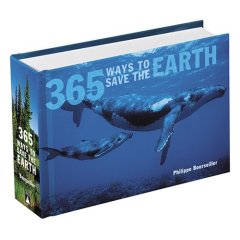
Okay kids, here's your reading assignment... don't worry there's lots of pretty pictures to distract you—365 of them to be exact. The photography in 365 Ways to Save the Earth by Philippe Bourseiller is absolutely gorgeous and it's coupled with bite-sized tips on how to be true to the title. One note, it make look small, but it weighs about 15 pounds.
Subscribe to:
Posts (Atom)